
“Man is not free from ignorance except when he knows that he is ignorant.” — Averroes

BOOKS BY UMAR RAFI

Stories and ideas across worlds.

A Children’s Playground book cover

Forthcoming · June 2027

A Children’s Playground

A Children’s Playground is a coming-of-age novel set against the backdrop of the Global War on Terror, exploring how love, loss, duty, and war shape the moral journey of one young man. Spanning continents, cultures, and religions in an alternate contemporary setting, it examines the timeless themes of class, family, faith, identity, and fate, asking what it truly means to become the person one is destined to be.

Born into a prominent tribal family along the Pakistan–Afghanistan border, Asad dreams of escaping the expectations of his lineage to build a life in Silicon Valley rather than succeeding his aging father as tribal chief. His carefully planned future is transformed when he meets Anna, a gifted musician and artist at Stanford University whose optimism, curiosity, and free spirit challenge everything he believes about love, happiness, and himself.

As their relationship deepens, tragedy strikes both worlds Asad calls home. A devastating drone strike in his remote mountain village leaves his childhood friend, Samina, critically injured and forces him to confront the human cost of a conflict he has spent years trying to leave behind. Torn between the life he longs to build in America and the responsibilities he has inherited in Pakistan, Asad embarks on a journey that will ultimately cost him the woman he loves—not once, but twice.

Stretching from the tribal mountains of the northwestern Pakistan–Afghanistan border to the heart of Silicon Valley, A Children’s Playground is ultimately the story of a boy becoming a man—discovering that the greatest battles are often fought not between nations, but within the human heart, where love and duty, ambition and sacrifice, hope and grief struggle to coexist.
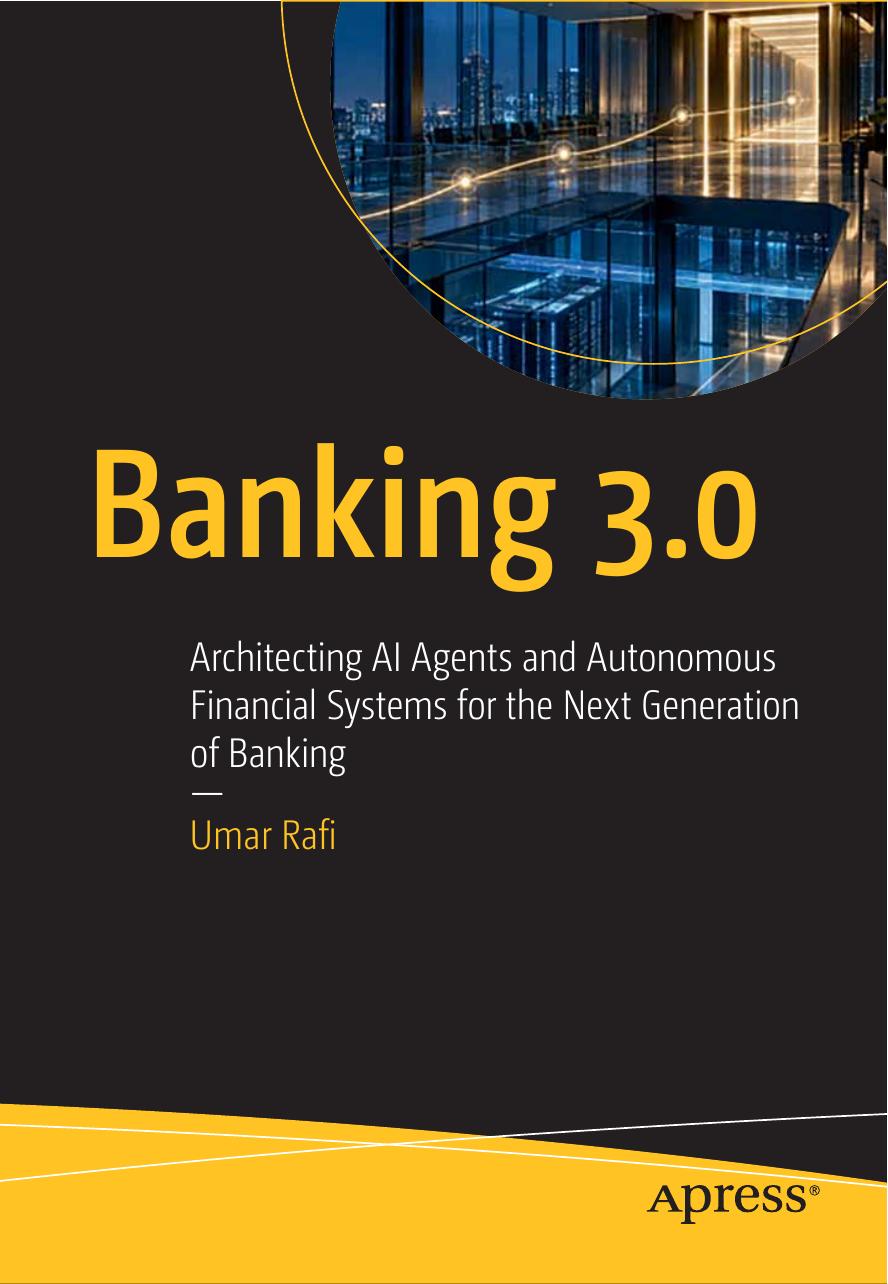

Banking 3.0 book cover

Forthcoming · December 2026

Banking 3.0

Banking has always been built on trust. For most of its history, that trust lived in people, and in the rules and systems built to remember what happened and to hold it true. Artificial intelligence introduces something different: software that can increasingly interpret, reason, decide, and act.

This book is about the architecture required for that transition. It describes banking through three overlapping eras: Banking 1.0, Banking 2.0, and Banking 3.0. Drawing in part on the author’s twenty-five-year journey through banking and financial-services transformation, it follows the institution from systems that record, to platforms that connect and inform, and finally to agents capable of carrying work.

Commercial products appear where they illuminate an architectural pattern, but the subject is banking architecture itself: the responsibilities that must remain visible as intelligence moves closer to execution.

At the heart of the book is a simple proposition: AI agents inherit the architecture beneath them.

They inherit its data and its gaps, its integrations and its fractures, its permissions and its ambiguities, its resilience, and its weaknesses. An agent does not escape the history of the enterprise simply because it stands at its newest edge.

Agents also inherit the rules that shaped that architecture. Banking regulation has spent decades turning obligations into systems, data requirements, permissions, controls, approval paths, and evidence. As intelligence becomes agency, some governance must move closer to the moment at which the agent reasons and acts. The architecture must establish not only what an agent can do, but what it may do, under what circumstances, on whose authority, and with what evidence left behind.

And the boundary must continue to hold. The bank must know whether the agent remains within it as models, data, tools, policies, and the systems around it change. Governance defines the boundary. Evaluation tests it. Operations must ensure that it endures.

This is not only a book about AI. It is about what must be true before intelligence is allowed to act—and what must remain true after it does.

Antifragility of Islamic Finance: The Risk-Sharing Alternative book cover

Published · 2018

Antifragility of Islamic Finance

Antifragility of Islamic Finance: The Risk-Sharing Alternative explains how risk-sharing, as defined under Islamic finance, makes financial systems antifragile. It highlights the benefits of 100% equity-based finance over debt-based finance.

The recent financial crisis has given rise to discussions on a new approach to risk management called antifragility. This concept specifies conditions under which systems become resilient to shocks caused by Black Swans—highly unpredictable outlier events that have a major negative (or positive) consequence when they occur, with their occurrence only explained retrospectively. Per this concept, the long-term survivability of any system centers exclusively on its antifragile nature, that is, its ability to absorb and even benefit from Black Swan–type shocks. This book aims to investigate risk-sharing Islamic finance as an antifragile system.

As a by-product of the Great Recession, the problems of debt-based financial systems are starting to be highlighted by industry and by academia. The antifragile solution for avoiding future financial crises is primarily centered on moving the existing financial system towards more equity and less debt, thereby introducing skin-in-the-game into financial transactions. This book introduces a model of a 100% equity-based financial system, centered on risk sharing, as a possible alternative to the contemporary debt-based, conventional financial system, which is based on risk transfer and on risk shifting. In essence, this book attempts to provide a practical model for an antifragile financial system by evaluating the characteristics of Islamic finance under the criteria of antifragility.