Punjabi is my mother tongue, a language whose poetry carries the rhythms of its native soil. The word derives from the Persian panj āb, “five waters”: the rivers that nourished Punjab’s fields and shaped the lives its poets sang about.
Where Urdu found refinement in royal and aristocratic courts, much of Punjabi’s poetic strength grew from the soil: the farmlands, village gatherings and shrines where people spoke of work, separation, injustice and love. Its power lies in earthier, more familiar words, brought alive by the voice: a change of tone, a pause or an emphasis can turn affection into mockery, a complaint into a joke, or a simple observation into something that stays with you.
The English poet reaches for the sublime, finding the soul’s reflection in mountains, lakes and the long reach of memory. The Persian poet builds palaces of metaphor, where wine is divine love, the tavern is the path to God, and the beloved may be human or heavenly. The Urdu poet, heir to both, folds philosophy, irony and heartbreak into a single couplet, every word weighed and polished in the courts of Delhi and Lucknow. The Punjabi poet, by contrast, sings of the rooster that wakes the village at dawn, the water buffalo lifting its head from the pond, and above all the five rivers that give his people life, love and longing. Yet, he speaks with such candour that his simplicity makes life’s deepest truths easy to understand. And it is that simplicity, more than any sophistication, that draws me to the soul of Punjabi.
In Pakistani Punjab, it is possible to grow up speaking Punjabi fluently while learning to read and write chiefly in Urdu and English. In Indian Punjab, its official status and close relationship with Sikhism have given its written tradition stronger support. Punjabi holds a distinctive place among the world’s languages: it gave a faith its formative voice. Guru Nanak, the Punjabi-born founder of Sikhism, carried his teachings through verse and song, giving the language an enduring place in Sikh devotion.
Too often absent from the page—a quiet loss for so widely spoken a language—Punjabi still shines in its oral tradition: in humour, wit and, above all, song. Its musical reach extends far beyond its homeland, giving it an outsized presence in the music of both India and Pakistan and among the diaspora: filling stadiums in Europe while still drawing listeners to shrines along the rivers of Punjab.
Urdu poetry taught me refinement; Punjabi poetry taught me honesty. These are the five Punjabi poets I return to most.
5. Shiv Kumar Batalvi23 July 1936 – 6 May 1973
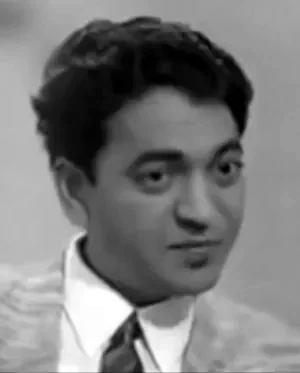
Shiv Kumar Batalvi was the poet of longing. Amrita Pritam called him Birha da Sultan (Sultan of Separation), and no modern Punjabi poet has written about loss with such sweetness and such pain.
He was born in 1936 in a village near Shakargarh, in what is now Pakistan, and his family moved to Batala in Indian Punjab after Partition, which gave him his name. His education was restless: he began degrees in arts, science and even engineering at several colleges, and finished none of them. He worked as a village revenue clerk and later in a bank, but poetry was the only work he truly did.
His collections include Piran da Paraga (A Basket of Sorrows), and in 1967 he became the youngest writer ever to receive the Sahitya Akademi Award, for Loona, a verse play that retells an old Punjabi legend from the point of view of its supposed villain, a young woman married to an old king. His songs are still sung across Punjab, among them this lament:
Ikk kudi jihda naam mohabbat
Gum hai, gum hai, gum haiThere is a girl whose name is Love
She is lost, lost, lost
His contribution was to bring the old Punjabi birha (the ache of separation) into modern life, and to make it personal. Where the Sufi poets longed for God, Shiv longed for a person, for youth, for a world that kept slipping away. Loona also showed a new sympathy: it gave a voice to a woman the old story had condemned. For readers far beyond Punjab, his songs became the sound of heartbreak itself.
He is at number five because I return more often to the poets above him. Yet his songs give modern sorrow a sweetness I find difficult to forget, and no account of my favourite Punjabi poets would be complete without him.
4. Amrita Pritam31 August 1919 – 31 October 2005
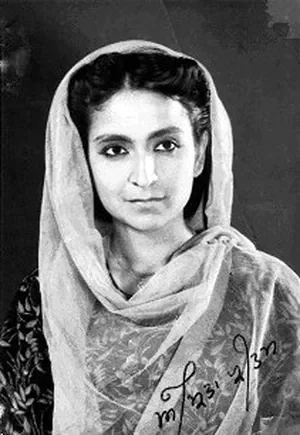
Amrita Pritam was a pioneering woman poet of Punjabi and one of Punjab’s boldest literary voices. Across six decades of poetry, novels and memoir, she challenged convention and gave the grief of Partition an unforgettable voice.
She was born in Gujranwala in 1919, the daughter of a schoolteacher and poet who encouraged her writing. Her mother died when she was eleven, and she found refuge in words; her first collection was published when she was sixteen. In 1947 Partition forced her family from Lahore to India, and she spent the rest of her life in Delhi, writing and editing, and for many years working for All India Radio.
Her poem Ajj Aakhaan Waris Shah Nu (Today I Call Waris Shah), which I have translated, was written in 1948 on a train journey from Dehradun to Delhi, a year after she had fled Lahore, as she mourned the women of Punjab who had suffered in the violence of Partition. It calls on the poet at number one on this list:
Ajj aakhaan Waris Shah nu, kiton qabraan vichon bol
Te ajj kitab-e-ishq da koi agla varka pholToday, I call Waris Shah, “Speak from inside your grave”
And turn, today, the book of love’s next affectionate page
Ajj Aakhaan Waris Shah Nu is my favourite poem in any language, and among the most difficult and powerful I have ever read. Translating it faithfully took me more than a year and a half. It captures the partition of Punjab: a province, a civilisation and an identity—my own—bound by centuries of shared life, then torn in two.
Her novel Pinjar (The Skeleton) told the story of a woman abducted during Partition, and her memoir Rasidi Ticket (The Revenue Stamp) spoke openly about love and freedom at a time when women were discouraged from doing so. She was the first woman to win the Sahitya Akademi Award and later received the Jnanpith Award, India’s highest literary honour.
Her contribution was to make Punjabi poetry speak for women, and to make it speak for both sides of a divided land. She was honoured in India and Pakistan alike, and her poem to Waris Shah is still recited on both sides of the border. Had she written only that one poem, it would have been enough for a lifetime. In a few verses, it holds all of Punjab, its old joys and its new grief: the Chenab, along whose banks Waris Shah’s Heer loved and suffered; the poet she calls upon to speak again; and Partition, the land’s deepest wound. For the world, she showed how a poet can hold a people’s grief without taking a side in its hatred.
She is at number four in my personal ordering, while the poem I love most remains hers. Her appeal to Waris Shah brings the older voices of Punjab into the grief of her own century; that conversation is part of what draws me to this collection.
3. Baba Faridc. 1179 – 1266
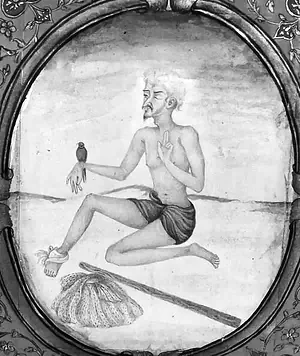
Baba Farid stands among the earliest surviving voices of Punjabi poetry. The verses preserved under his name bring the questions of a Sufi tradition into the language of ordinary people.
Fariduddin Masud was born near Multan in the late twelfth century, into a family of scholars. His mother taught him prayer and devotion, and he was educated in Multan in the Quran, theology and Persian. There he met the Sufi master Qutbuddin Bakhtiar Kaki and followed him to Delhi as a disciple of the Chishti (Sufi) order. In time he settled at Ajodhan, now Pakpattan in Pakistan, where he lived simply among the poor, and where his shrine still draws pilgrims. He became known as Ganjshakar (Treasury of Sugar) for the sweetness of his words and his life.
The verses attributed to him are short shaloks (couplets) of startling plainness about death, humility and longing for God. More than a hundred of them were included in the Guru Granth Sahib, the holy book of the Sikhs, compiled more than three centuries after his death. Their transmission spans centuries, and the attribution of some verses remains debated. Among the most loved:
Kaga karang dhandholia, sagla khaiya maas
Eh do naina mat chhuhyo, pir dekhan ki aasO crow, you have picked my skeleton and eaten all my flesh
But do not touch these two eyes; they still hope to see my Beloved
The tradition associated with Baba Farid gave Punjabi an enduring early literature of the spirit. His couplets are recited by Muslims at his shrine and sung by Sikhs in their gurdwaras (Sikh temples), a rare meeting of faiths in a single voice. For the world, he is proof that the simplest words, spoken with sincerity, can outlast empires.
He is at number three because I turn more often to the bold questioning of Bulleh Shah and the storytelling of Waris Shah. Farid’s plainness offers another kind of companionship: a few words that stay long after the verse ends.
2. Abdullah “Bulleh” Shahc. 1680 – 1757
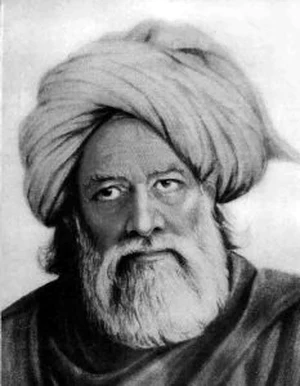
Bulleh Shah is Punjab’s rebel saint. He mocked the clergy, ignored the boundaries of caste and creed, and danced in the streets for his teacher. Three centuries later, his poetry is sung everywhere from village shrines to concert halls. He belongs to a long line of Sufis who lived along the Indus, from Punjab down to Sindh.
No poet, in fact no philosopher, has shaped my thinking and approach to life more than Bulleh Shah. I have found wisdom in thinkers as distant from one another as Aristotle and Ibn Arabi, Seneca and Iqbal. Yet it is this rural Sufi saint, remembered in local tradition as a man who travelled little beyond the small Punjabi town that shaped his world three centuries ago, who speaks most directly to me. Perhaps it is because we share the same soil, the same mother tongue and a faith understood through love for others. His words bring the great questions of existence into the language of home.
I write my poetry under the pen name Bulleya, in his honour. In fact, I wrote the final draft of my novel under the name Abdullah Shah, another tribute to this remarkable man. I changed it to my own name only at the urging of reviewers, who felt that a novel born of such a personal journey of discovery should carry the name of the person who had made that journey.
Abdullah “Bulleh” Shah was born in 1680, probably in Uch in present-day Bahawalpur, Pakistan, into a respected family of Sayyids (descendants of the Prophet), and grew up near Kasur, where his father taught at the village mosque. He studied Arabic, Persian and theology, and was expected to become a learned man of religion. Instead he became the disciple of Shah Inayat Qadiri, a gardener by family trade and a Sufi master, to the outrage of his family, who felt a Sayyid should not bow to a man of lower status. He never married, and spent his life in and around Kasur, where he died in 1757.
According to local tradition, his defiance of the clergy followed him to the grave: the orthodox religious clerics of Kasur refused to give him a religious funeral or a place in the town’s graveyard, and he was buried outside the city. Ironically, the city of Kasur has since grown around his shrine, which now stands at its heart; history, in the end, sided with the poet the people loved, not the clerics who shut him out.
He wrote mostly kafis (short lyrics with a refrain), meant to be sung. His most famous asks the oldest question of all, and I have translated it:
Bulleh! ki jaana maen kaun
Na maen momin vich maseet aan
Na maen vich kufar diyan reet aan
Na maen paakaan vich paleet aan
Na maen moosa na pharaun
Bulleh! ki jaana maen kaunBulleh! To me, I am not known
Not a believer inside the mosque, am I
Nor a pagan disciple of false rites
Not the pure amongst the impure
Neither Moses, nor the Pharaoh
Bulleh! To me, I am not known
His poetry places love above ritual and the human heart above inherited labels. Its sharpest questions challenge the pride of birth and the self-righteousness of religious and social authority. The cleric and the judge become recurring figures through whom he asks whether learning and respectability have made a person more compassionate.
His kafis are sung by Punjabis of many faiths. Their words travel through qawwali—the devotional music of Sufi shrines—Sufi song, folk music, solo ballads and rock, carrying love and defiance to new listeners.
For me, the thread running through these songs is that love of humanity brings us closer to God. His village idiom makes that conviction intimate: a spiritual question heard in the language of home.
If Amrita Pritam wrote my favourite poem in any language, a couplet traditionally attributed to Bulleh Shah is my favourite:
Masjid dha de, mandar dha de; dha de jo kujh dhainda
Par kisi da dil na dhaween; Rabb dilaan vich rehndaTear down mosques, tear down temples; and all that stands besides
But never tear down a person’s heart; for that is where God resides
A popular four-line stanza traditionally attributed to him turns to Layla and Majnun, the lovers of Arabic legend. It asks us to see beauty through the lover’s eyes, beyond the judgements of complexion and appearance:
Keeta sawaal Mian Majnun nu, teri Laila te rang di kaali
Ditta jawaab Mian Majnun ne, teri akh na vekhan waali
Quran paak de warq ne chitte, utte likhi siyaahi kaali
Chhad ve Bulleya, jithe dil arr jaave, othe ki gori ki kaaliThey taunted Majnun: “Your Laila’s skin is black”
Majnun smiled: “It’s an eye for beauty that you lack
The Quran’s pages are white, yet black is its every mark
Let it go, Bulleya! Where hearts surrender, who cares if she is fair or dark?”
He is at number two because the poet at number one did something even Bulleh Shah did not: he wrote the epic of Punjab, the story through which a whole people still understands love.
1. Waris Shahc. 1722 – c. 1798
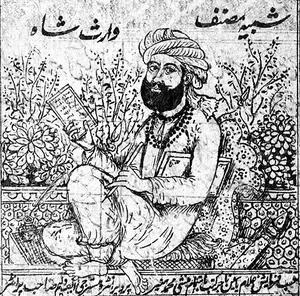
Waris Shah is the Shakespeare of Punjab. His Heer, the tragic love story of Heer and Ranjha, is the epic of the Punjabi language: a long tale told entirely in verse. For more than two centuries it has been recited, sung and quoted wherever Punjabi is spoken, becoming the best-known telling within an older Punjabi romance tradition and inspiring countless later retellings. The names themselves have entered the language: a Punjabi woman in love is a Heer, and a Punjabi man in love is a Ranjha.
Waris Shah was born around 1722 in Jandiala Sher Khan, near the Punjab town of Sheikhupura in Pakistan. He was educated in Kasur in religious learning and Persian. After years of wandering, he settled in the village of Malka Hans, near Pakpattan, where he lived in a small room beside the mosque. There, in 1766, he completed Heer, taking an old folk tale and turning it into a poem of extraordinary depth and detail. He died in 1798, and lies in a large tomb with a wide courtyard in his home town of Jandiala Sher Khan. To this day, devotees gather at his tomb to sing Heer, honouring the vision of love the great poet wove into Punjabi life.
Like many great Punjabi romances, the story of Heer and Ranjha is set beside one of Punjab’s five rivers, here the Chenab, and, like many Punjabi folk tales, it is full of sacrifice, defiance and, in the end, tragedy. Heer, the breathtakingly beautiful daughter of a village chief in Jhang, falls in love with Ranjha, a young wanderer from across the river who arrives with nothing but his flute and becomes her father’s cattle herder. Through this poem, his flute became the instrument of Punjabi romance; ever since, many young Punjabi men have tried their hand at learning it, as I did, rather unsuccessfully, in my early twenties.
As for Heer, her defiance of family, clan and clergy in the name of love made her a symbol of Punjabi women’s resistance.
Heer is a love story, but it is also a portrait of eighteenth-century Punjab: its villages and rivers, its marriages and quarrels, its saints and hypocrites, its music and its humour. It opens by placing love at the root of creation:
Awwal hamd Khuda da wird keejay
Ishq keeta su jag da mool miyanFirst, let us praise God
Who made love the root of the world
Waris Shah spends pages describing Heer herself, in what must be one of the finest and most detailed descriptions of female beauty in any language. For me, Heer is a touchstone of Punjabi poetry, and singing it remains a test of a Punjabi singer’s expressive range.
Waris Shah enriched Punjabi with vivid characters and expressions that became everyday proverbs, turning a village romance into a mirror of human nature. For the world, Heer is one of the great love stories, alongside Romeo and Juliet and Layla and Majnun, and its singing remains a living art. Its sustained, metred storytelling gives the romance a life that can be heard as well as read.
Waris Shah was a younger contemporary of Bulleh Shah. Local tradition links them through the teacher Hafiz Ghulam Murtaza in Kasur—a shared lineage remembered through stories rather than a fully documented record.
One such story has Waris present Heer to his teacher, who initially laments that one pupil sang and danced while the other wrote a romance. Hearing the poem, he recognises a deeper longing and blesses it as priceless pearls strung into a rosary.
Two poets, one Punjab—and a remembered teacher linking love, song and spiritual longing.
Waris Shah is at number one because, for me, no other poet holds so much of Punjab in a single story. When Amrita Pritam needed someone to speak for the grief of Partition, it was Waris Shah she called from his grave. Professor S. Soze, in his Sahitya Akademi book on Shiv Kumar Batalvi, describes Shiv as a “dashing Ranjha-type figure.” Heer and Ranjha remain a shared language of love, quoted far beyond the poem. That enduring presence is what gives Waris his place at the top of my list.